Tea by the Tigris, ancient paths, volcanic lakes and sacred stones; Eastern Türkiye like you’ve never seen.
What to expect
Itinerary
Day 1
Goodbye, South Africa
We meet at the check-in counters of Turkish Airlines at the OR Tambo International Airport for our flight to Ankara.
Day 2
Merhaba Türkiye!
Ankara is the capital city of Türkiye. On arrival in Ankara, we visit the Ancient Civilizations Museum of Türkiye. It has been voted one of the best museums in Europe! This museum houses one of the best and most beautiful collections in the world. There are, for instance, examples of the settlements in chronological order of all the different civilisations that occurred in Anatolia.
The rest of the afternoon is at leisure to get rid of the jetlag or stroll in the city or its parks.
Highlights:
Ancient Civilizations Museum of Türkiye visit
Leisure time in Ankara
Day 3
Legacy of the Hittite Empire
After breakfast we travel to Hattusha. Although the Hittite Empire vanished thousands of years ago, it has by no means been forgotten. Its capital, Hattusha, has been declared a UNESCO World Heritage Site.
This city was founded on the site of an earlier settlement in about 1900 BC. It soon gained importance because the town had a karum (market) where a colony of Assyrian merchants had settled. During this time, the Hittites had preserved memories of their kings who had ruled from a city called Kussara, which has not been located.
The remains of five temples have been discovered in the city. Temple 1 is the most impressive and gives us an idea of the religious life of the Hittites.
The older part of the city stretches across the lower slopes of the hill above modern-day Boğazköy, continuing up to the high stronghold of Büyükkale in the southeast, where remnants of the ancient city walls still stand.
By the 14th century BC, the city had grown in size and significance, prompting the expansion of its fortifications to protect the elevated areas. At its height, the city was enclosed by walls covering an area of approximately 300 acres.
A century later, the nearby hill of Büyükkaya to the east was also enclosed and linked to the main city by a bridge. The newly built southern walls were especially impressive, showcasing both strength and sophisticated design. They featured stone-faced ramparts, outer curtain walls, and cleverly designed sally ports. Tower-flanked gateways with arches were adorned with intricate sculptures, reflecting the city’s architectural prowess.
Highlights:
UNESCO-listed Hattusha
Ancient temples and city walls
Day 4
Coastal Exploration
Today, we journey along the beautiful Turkish coastline, passing through the charming towns of Ünye, Ordu, and Giresun—famously known as the land of cherries—en route to Trabzon.
If time allows, we’ll explore the Church of St. Sophia and the city centre before checking into our hotel. Depending on our arrival, we may also visit the Sumela Monastery either later today or early tomorrow morning.
Highlights:
Black Sea drive through the land of cherries
Trabzon city centre & St. Sophia
Optional visit to Sumela Monastery
Day 5
Seljuk Marvels
After breakfast, we depart for Erzurum, the largest province in Eastern Anatolia. Historically a major transportation hub, Erzurum continues to serve as a key transfer point for air, rail, and bus connections to Eastern Türkiye.
The city’s history dates back to 4000 BC, with one of its most notable remnants being the remarkably well-preserved ancient city walls.
Highlights:
Historic Erzurum
Ancient city walls
Day 6
Explore Ancient Ani’s Rich Heritage
After breakfast, we depart for Ani, travelling along the ancient Silk Road.
Explore the legendary ruins of Ani, a city once known as the “World City,” “Cradle of Civilizations,” “City of 1001 Churches,” and “City of 40” proudly listed as a UNESCO World Heritage Site.
Once the capital of a powerful mediaeval Armenian kingdom, Ani dazzled with its rich cultural layers and architectural beauty. Today, its ruins reveal centuries of Christian and Muslim influence, offering a fascinating glimpse into mediaeval urban life.
Highlights of our visit include the Cathedral of Ani, the Menüçehr Mosque, and the Tigran Honents Church.
Highlights:
Ruins of Ani (UNESCO)
Cathedral, mosque and churches
Day 7
Majestic Mount Ararat
After breakfast, we depart for Mount Ararat, the highest mountain in Türkiye at 5,165 metres above sea level and a symbol of the Ağrı region. Ararat is a dormant volcano, usually covered in snow. According to tradition, this is where Noah’s Ark came to rest and where the second creation of the world began.
At the foot of Mount Ararat lies the wide and fertile plain of Iğdır, believed to be the first dry land where Noah set foot after the flood. We’ll stop for lunch at a local restaurant (own account).
Later, we continue to the Ishak Pasha Palace, located 6 km from town. This is the region’s most significant historical site, built in the 17th century by Ishak Pasha, an Ottoman governor. The palace features a fascinating mix of architectural styles and has undergone several restorations.
Our journey then continues to Lake Van.
Highlights:
Views of Türkiye’s highest peak
Ishak Pasha Palace
Journey to Lake Van
Day 8
A lake, a fortress and an ancient church
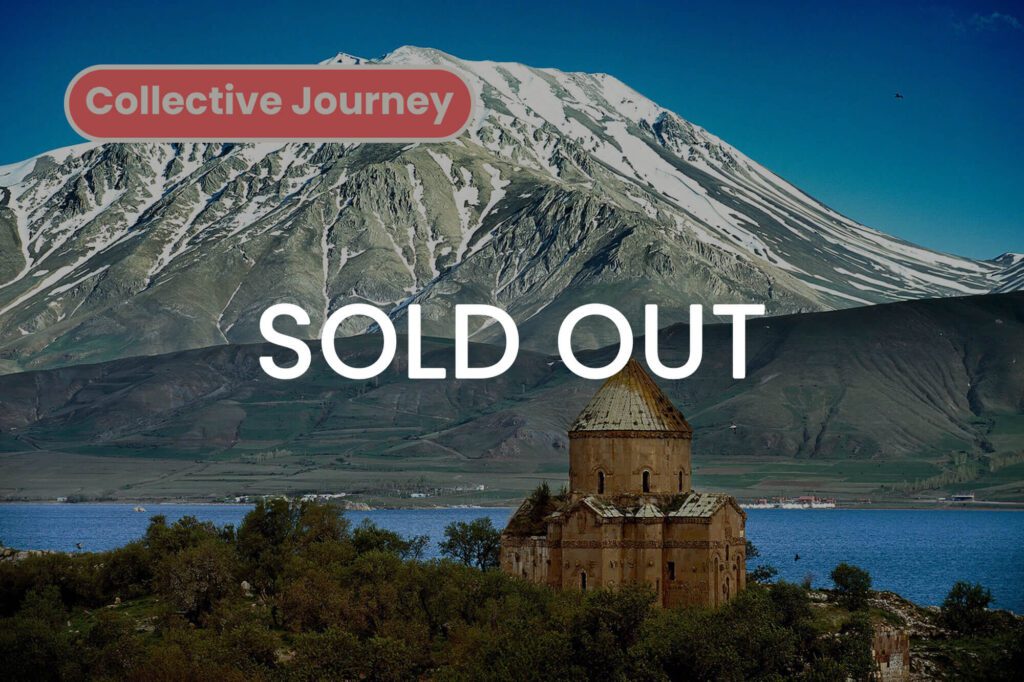
We spend the day exploring Van and its surroundings, including a visit to Lake Van and the historic Van Fortress. A highlight of the day is a boat trip to Akdamar Island, where we visit a 700-year-old church built by King Gagik I of Armenia. Stories from the Old Testament are intricately engraved on the church’s outer walls. After years of restoration, the church was reopened for services in 2010.
We also explore the ancient Urartian ruins of Çavuştepe, originally constructed by King Sarduri II in 700 BC.
As the day ends, we enjoy the sunset over the lake from our hotel — perhaps with a cocktail in hand (at your own expense!).
Highlights:
Boat trip to Akdamar Island
Van Fortress & Çavuştepe ruins
Sunset over Lake Van
Day 9
Picnic by the Tigris
Our journey takes us to Hasankeyf, situated on the banks of the Tigris River, once an old Seljuk capital. This afternoon we have a picnic next to the river before we set off to Mardin. This unusual town is in Upper Mesopotamia and built of sandstone against the rock cliffs.
Highlights:
Picnic in Hasankeyf
Arrival in hilltop Mardin
Day 10
Urfa’s Ancient Charms
We begin with a visit to the Jacobite Monastery of Deyrulzafaran, which, along with the nearby Deyrulumur Monastery, has been in continuous use for centuries. Both are part of the Syriac Orthodox Church and are renowned for their distinctive architecture. The language spoken here closely resembles that spoken by Jesus and his disciples, and the deep sense of spirituality is tangible. There will be an opportunity to speak with the monks.
Mardin, one of Türkiye’s most picturesque stone towns, invites us to explore its narrow lanes and historic charm before we continue to Urfa.
In Urfa—widely believed to have been the capital of the Hurrians — we delve into rich layers of religious and cultural history. While the Bible names “Ur of the Chaldeans” as Abraham’s birthplace, many scholars suggest this refers to Urfa, not far from Haran (to which Abraham travelled). Later known as Edessa, the city also hosted some of the earliest Christian communities.
We conclude with a visit to the cave where, according to tradition, Abraham was born.
Highlights:
Visit active Syriac monastery
Explore Mardin & Abraham’s cave in Urfa
Day 11
Mesopotamian Marvels
This morning, we visit Harran (or Haran), located south of Urfa.
The landscape stretches into the flat Mesopotamian plain, dotted with ancient mounds and remote mud-brick villages. Today, these villages are connected to electrical grids, and with the promise of prosperity through irrigation, many locals are investing in modern “luxuries” such as refrigerators and televisions.
This region, once among the poorest and least developed in Türkiye, is now undergoing remarkably rapid change.
Highlights:
Harran’s mud-brick villages
Glimpse into ancient Mesopotamia
Day 12
Baklava and Mosaics
After breakfast, we drive to Gaziantep, stopping en route to visit Göbekli Tepe – recently opened to the public and recognised as the world’s oldest religious temple, dating back 12,000 years.
Upon arrival in Gaziantep, we explore the Zeugma Mosaic Museum, the largest of its kind in the world. Here, we’ll admire priceless mosaics and uncover fascinating mythological stories.
If time permits, we will also visit Gaziantep Castle and the Coppersmith Bazaar.
Highlights:
Göbekli Tepe temple
Zeugma Mosaic Museum
Optional: Gaziantep Castle & Coppersmith Bazaar
Day 13
In the footsteps of St. Paul
After breakfast, we drive to Antioch On Orentes. We visit the cave where believers were first called ‘Christians’. This is now a museum and well worth a visit. St. Paul gave his first sermon in this cave, which was later turned into a church with additional features. St. Paul used Antioch as his base as he carried out his activities to spread Christianity.
We then drive to Hatay Airport for our flight to Istanbul. Later, we depart for Johannesburg.
Highlight:
Cave church in Antioch
We meet at the check-in counters of Turkish Airlines at the OR Tambo International Airport for our flight to Ankara.
Ankara is the capital city of Türkiye. On arrival in Ankara, we visit the Ancient Civilizations Museum of Türkiye. It has been voted one of the best museums in Europe! This museum houses one of the best and most beautiful collections in the world. There are, for instance, examples of the settlements in chronological order of all the different civilisations that occurred in Anatolia.
The rest of the afternoon is at leisure to get rid of the jetlag or stroll in the city or its parks.
Highlights:
Ancient Civilizations Museum of Türkiye visit
Leisure time in Ankara
After breakfast we travel to Hattusha. Although the Hittite Empire vanished thousands of years ago, it has by no means been forgotten. Its capital, Hattusha, has been declared a UNESCO World Heritage Site.
This city was founded on the site of an earlier settlement in about 1900 BC. It soon gained importance because the town had a karum (market) where a colony of Assyrian merchants had settled. During this time, the Hittites had preserved memories of their kings who had ruled from a city called Kussara, which has not been located.
The remains of five temples have been discovered in the city. Temple 1 is the most impressive and gives us an idea of the religious life of the Hittites.
The older part of the city stretches across the lower slopes of the hill above modern-day Boğazköy, continuing up to the high stronghold of Büyükkale in the southeast, where remnants of the ancient city walls still stand.
By the 14th century BC, the city had grown in size and significance, prompting the expansion of its fortifications to protect the elevated areas. At its height, the city was enclosed by walls covering an area of approximately 300 acres.
A century later, the nearby hill of Büyükkaya to the east was also enclosed and linked to the main city by a bridge. The newly built southern walls were especially impressive, showcasing both strength and sophisticated design. They featured stone-faced ramparts, outer curtain walls, and cleverly designed sally ports. Tower-flanked gateways with arches were adorned with intricate sculptures, reflecting the city’s architectural prowess.
Highlights:
UNESCO-listed Hattusha
Ancient temples and city walls
Today, we journey along the beautiful Turkish coastline, passing through the charming towns of Ünye, Ordu, and Giresun—famously known as the land of cherries—en route to Trabzon.
If time allows, we’ll explore the Church of St. Sophia and the city centre before checking into our hotel. Depending on our arrival, we may also visit the Sumela Monastery either later today or early tomorrow morning.
Highlights:
Black Sea drive through the land of cherries
Trabzon city centre & St. Sophia
Optional visit to Sumela Monastery
After breakfast, we depart for Erzurum, the largest province in Eastern Anatolia. Historically a major transportation hub, Erzurum continues to serve as a key transfer point for air, rail, and bus connections to Eastern Türkiye.
The city’s history dates back to 4000 BC, with one of its most notable remnants being the remarkably well-preserved ancient city walls.
Highlights:
Historic Erzurum
Ancient city walls
After breakfast, we depart for Ani, travelling along the ancient Silk Road.
Explore the legendary ruins of Ani, a city once known as the “World City,” “Cradle of Civilizations,” “City of 1001 Churches,” and “City of 40” proudly listed as a UNESCO World Heritage Site.
Once the capital of a powerful mediaeval Armenian kingdom, Ani dazzled with its rich cultural layers and architectural beauty. Today, its ruins reveal centuries of Christian and Muslim influence, offering a fascinating glimpse into mediaeval urban life.
Highlights of our visit include the Cathedral of Ani, the Menüçehr Mosque, and the Tigran Honents Church.
Highlights:
Ruins of Ani (UNESCO)
Cathedral, mosque and churches
After breakfast, we depart for Mount Ararat, the highest mountain in Türkiye at 5,165 metres above sea level and a symbol of the Ağrı region. Ararat is a dormant volcano, usually covered in snow. According to tradition, this is where Noah’s Ark came to rest and where the second creation of the world began.
At the foot of Mount Ararat lies the wide and fertile plain of Iğdır, believed to be the first dry land where Noah set foot after the flood. We’ll stop for lunch at a local restaurant (own account).
Later, we continue to the Ishak Pasha Palace, located 6 km from town. This is the region’s most significant historical site, built in the 17th century by Ishak Pasha, an Ottoman governor. The palace features a fascinating mix of architectural styles and has undergone several restorations.
Our journey then continues to Lake Van.
Highlights:
Views of Türkiye’s highest peak
Ishak Pasha Palace
Journey to Lake Van
We spend the day exploring Van and its surroundings, including a visit to Lake Van and the historic Van Fortress. A highlight of the day is a boat trip to Akdamar Island, where we visit a 700-year-old church built by King Gagik I of Armenia. Stories from the Old Testament are intricately engraved on the church’s outer walls. After years of restoration, the church was reopened for services in 2010.
We also explore the ancient Urartian ruins of Çavuştepe, originally constructed by King Sarduri II in 700 BC.
As the day ends, we enjoy the sunset over the lake from our hotel — perhaps with a cocktail in hand (at your own expense!).
Highlights:
Boat trip to Akdamar Island
Van Fortress & Çavuştepe ruins
Sunset over Lake Van
Our journey takes us to Hasankeyf, situated on the banks of the Tigris River, once an old Seljuk capital. This afternoon we have a picnic next to the river before we set off to Mardin. This unusual town is in Upper Mesopotamia and built of sandstone against the rock cliffs.
Highlights:
Picnic in Hasankeyf
Arrival in hilltop Mardin
We begin with a visit to the Jacobite Monastery of Deyrulzafaran, which, along with the nearby Deyrulumur Monastery, has been in continuous use for centuries. Both are part of the Syriac Orthodox Church and are renowned for their distinctive architecture. The language spoken here closely resembles that spoken by Jesus and his disciples, and the deep sense of spirituality is tangible. There will be an opportunity to speak with the monks.
Mardin, one of Türkiye’s most picturesque stone towns, invites us to explore its narrow lanes and historic charm before we continue to Urfa.
In Urfa—widely believed to have been the capital of the Hurrians — we delve into rich layers of religious and cultural history. While the Bible names “Ur of the Chaldeans” as Abraham’s birthplace, many scholars suggest this refers to Urfa, not far from Haran (to which Abraham travelled). Later known as Edessa, the city also hosted some of the earliest Christian communities.
We conclude with a visit to the cave where, according to tradition, Abraham was born.
Highlights:
Visit active Syriac monastery
Explore Mardin & Abraham’s cave in Urfa
This morning, we visit Harran (or Haran), located south of Urfa.
The landscape stretches into the flat Mesopotamian plain, dotted with ancient mounds and remote mud-brick villages. Today, these villages are connected to electrical grids, and with the promise of prosperity through irrigation, many locals are investing in modern “luxuries” such as refrigerators and televisions.
This region, once among the poorest and least developed in Türkiye, is now undergoing remarkably rapid change.
Highlights:
Harran’s mud-brick villages
Glimpse into ancient Mesopotamia
After breakfast, we drive to Gaziantep, stopping en route to visit Göbekli Tepe – recently opened to the public and recognised as the world’s oldest religious temple, dating back 12,000 years.
Upon arrival in Gaziantep, we explore the Zeugma Mosaic Museum, the largest of its kind in the world. Here, we’ll admire priceless mosaics and uncover fascinating mythological stories.
If time permits, we will also visit Gaziantep Castle and the Coppersmith Bazaar.
Highlights:
Göbekli Tepe temple
Zeugma Mosaic Museum
Optional: Gaziantep Castle & Coppersmith Bazaar
After breakfast, we drive to Antioch On Orentes. We visit the cave where believers were first called ‘Christians’. This is now a museum and well worth a visit. St. Paul gave his first sermon in this cave, which was later turned into a church with additional features. St. Paul used Antioch as his base as he carried out his activities to spread Christianity.
We then drive to Hatay Airport for our flight to Istanbul. Later, we depart for Johannesburg.
Highlight:
Cave church in Antioch
Experience the vibrance of Eastern Türkiye with Hannes Noëth
In the footsteps of the Old Testament Fathers
Get ready for an unforgettable journey through the hidden eastern frontier of Türkiye. From the ancient Hittite capitals and stunning cliffside monasteries to sacred mountains and towns shaped by stone, this boutique adventure follows the paths of prophets, traders, and kings.
Enjoy a cup of tea by the Tigris, sail across a mesmerising volcanic lake, and explore archaeological wonders that predate the pyramids. With every step, you’ll uncover a new layer of history—mystical, fascinating, and truly moving.
Our approach
We care about our guests
Seagull Travel & Tours crafts small group tours that offer luxury, convenience, and spontaneous moments of joy.
“Seagull Tours is well au-fait with all aspects of the travel industry, on an organising as well as a human touch level. From the moment you make contact with Seagull Travel & Tours’ operators until the end of the tour, you always feel welcome and treated in a caring and considerate way!”
Sanet KosterCaring
“Morocco with Seagull was an unforgettable experience for several reasons. Linde's genuine care and personal attention was exceptional, and she always made sure that everyone was comfortable, satisfied, and happy.”
Cobus CoetzeeConvenience: Luxurious, experienced
“I have been on eight Seagull tours to various countries, and I can highly recommend the Seagull team and tours. The tour groups are small, the guides professional, friendly, and caring, and they try to accommodate the needs and interests of everyone. It feels more like a family holiday than an official tour. The booking process is also easy, without hassles.”
Rynhardt van RooyenA human touch: Welcoming, caring, considerate
“The visit to Japan was the fourth time that I have experienced the convenient and luxurious way in which Seagull Tours approaches their tours and travellers. Seagull Tours is highly experienced in the travel industry and develops all its tours and offerings in an exponential manner to ensure that each tour not only consists of scheduled itinerary activities but surprises its travellers with spontaneous experiences and moments of delight.”
Sanet KosterSpontaneous experiences: Moments of delight, memories
“How does one travel without the experts at Seagull Travel & Tours? Seagull makes a tour feel more like a family outing! Everything is perfectly organised, giving guests the added benefit of ultra-personalised service.”
Charles en Marietjie EmslieConvenience: Luxurious, experienced
Charles en Marietjie EmslieConvenient
Cobus CoetseeConvenience
"Seagull's bespoke small group tours have never failed to over-deliver on our expectations. By now, we are comfortable with the knowledge that Seagull's expert team will have all the travel arrangements well under control. Hotel selection, local expert guides, exposure to local cuisine, street food, and off-the-beaten-track surprises are all standard elements that contribute to a truly immersive experience of the culture and sights of every destination."
Philip GibsonOver-deliver on our expectations
“So many memories. Proud to be part of this awesome family!”
Sanet KosterFamily
“Seagull Tours have made it their business to offer travellers an understanding of how enriching and exciting it could be to discover new landscapes, unknown customs, scrumptious traditional dishes in the wake of experienced guides, and itineraries expertly chosen to bring you the best of what a country has to offer in the available time.”
Naòmi MorganItineraries expertly chosen
“Thank you, Elizabeth, for caring for each individual traveller. We’re already planning a reunion tour!”
Annebie and Ben de KlerkCaring
“Your service is exceptional. Every experience with Seagull has been extraordinary!”
Dr. Salomine TheronExtraordinary
“Seagull Tours means value for money, safety, convenience, fun experiences, and that welcoming personal touch. Can’t wait for our next trip!”
Julius and Madelene GersValue for money, safety and convenience
“What makes Seagull Tours so unique? Well, for me it's definitely consistency. I know that I signed up for a well-researched and organised tour, excellent accommodation, meals and transport, and a unique experience with Seagull Tours. I have never been disappointed.”
Elna RittenConsistency
“The cleverly planned tour itinerary ensured that we experienced the highlights of each destination in full within the allotted timeframe. Furthermore, the accommodation was always luxurious and convenient. We recommend Seagull Tours to all our friends!”
Pieter MulderCleverly planned tour itinerary
“Travelling with Seagull is like travelling with family – the only difference is you don't become involved with any of the problems that may arise. The whole trip is smooth sailing, and every hiccup is taken care of immediately.”
Suzette BosmanSmooth sailing
“The Seagull team is always available to guide you in choosing one of their exciting tours. Moreover, every Seagull tour is a celebration! Come along and discover the fun for yourself. You won’t regret it!”
Leonora van StadenYou won’t regret it
“Thank you for your noteworthy organisational skills and for the calm way in which you solved our luggage debacle. We immediately realised that we were in very capable hands travelling with Seagull. It was a privilege to be introduced to Seagull’s professionalism and excellence!”
Gerhard and Isolde BeukesProfessionalism and excellence
“Thank you for the way you make every traveller feel welcome and at home!”
Anita LandmanFeel welcome and at home
Read more
“I've been travelling with Seagull for more than ten years, and my experience is that all the tours were well-organised and the accommodation was good value for money.”
Pierre JordaanGood value for money
“Seagull Tours keep their groups small and manageable, and most of the time, you return home with lifelong friends. I really can't wait to book my next adventure with Seagull Tours.”
Elna RittenLifelong friends
“We love travelling with Seagull. Everything is high quality, from the tour leader to the hotels. I love the fact that they are experienced: the tour leaders know exactly what to expect, and they know tour guides in other countries.”
Suzette BosmanWe love travelling with Seagull
“We have travelled wide and far with Seagull Tours, and it has always been a delight. It is with great excitement that we are looking forward to our next trip with Seagull Tours, making some more beautiful memories.”
Reg and Maureen JagerBeautiful memories
“The support from the Seagull admin team, the expertise of their tour guides, the diversity of tours offered, and the small group sizes all contribute to the fact that Seagull Travel & Tours is in a league of its own! If you haven’t seen the world with Seagull yet, you have much to catch up on.”
Charles en Marietjie EmslieSupport and expertise
“The tour guides’ expertise and knowledge of each country we travelled to, coupled with their compassion for each traveller, made a highlight of each and every on-tour experience!”
Anita LandmanExpertise and knowledge
“The diversity that Seagull offers is amazing, from scenic nature trips to Serengeti and Masai Mara, cultural journeys to Turkey and India, culinary adventures to Morocco with excellent photographic opportunities to sightseeing experiences in South America, including Machu Picchu, Iguazu waterfalls, the glaziers in Chile, excellent steaks and the Tango show in Buenos Aires, and nice Malbec wine from Santiago de Chile.”
Pierre JordaanAmazing
“The tour leaders were always very caring, considerate, and well-experienced. The fact that the groups are smaller makes it easier to engage with everyone, and tour members become lifelong friends.”
Pierre JordaanVery caring, considerate, and well-experienced
“Travelling with Seagull is a unique experience: the groups are small, but the consideration of each traveller’s individual needs is noteworthy. Luxurious and curated, these tours also include ample shopping time.”
Marthie BadenhorstUnique experience
“With Seagull, one feels safe, at home immediately, which is one of the many reasons we travel with them, again and again.”
Barnie and Alda NiemandSafe
“Seagull tours always include well-organised extras, or surprises if you will, which is often unheard of! The nature of these small group tours is unique since close bonds form among travellers. Thank you, Seagull! I look forward to spoiling myself on yet another exceptional trip.”
Irma du PlessisWell-organised extras
“I had amazing experiences like a hyena killing a buffalo whilst the same herd was charging lions. I also experienced amazing sunsets at the Serena Serengeti Hotel whilst relaxing with friends. My trips to other parts of the world like Norway and Sweden included amazing sightings of the Northern lights and a trip to Morocco which tested your culinary senses.”
The tour leader collects a set amount from each member of a tour. This kitty is then used to tip the local tour guide and city guides, bus drivers, any other assistants, and restaurant staff. We believe in tipping for good service as a token of appreciation, especially as many workers in tourism rely on tips to supplement their income.
Although we cannot apply on your behalf, we are more than willing to give guidance and assistance with completing forms. We do this for many clients on a near-daily basis. It does, however, remain the responsibility of the client to ensure that they get the correct visa on time.
Remember that we limit the number of guests on our tours. This means more time at stops and sites. We definitely do not do groups of 30 pax, where guests are rushed from one site to the other. There is enough time to explore on your own.
We always suggest USD/Euro 50 to USD/Euro 100 per person per day. As we mostly include two meals per day on our tours, this will be enough for lunch/dinner, some snacks, and memento shopping. Should you want to buy larger items, we suggest taking along your credit card. Remember to advise the bank that you will be travelling.
Once you have completed the form, you will receive an email with the itinerary which includes pricing, inclusions and flight options.