A Korean Spring

7 Apr –
20 Apr 2027

NEW TOUR

Art, Philosophy and the Shape of Daily Life.

What to expect

Itinerary

Day 1
Departure from Johannesburg

Your journey to South Korea begins with an overnight flight from Johannesburg to Seoul. The flight crosses several time zones, and you arrive in Seoul the following morning.

If you are joining this journey as a continuation of our Japan in Bloom tour, you fly today from Tokyo to Seoul instead.

Day 2
Seoul: Arrival

You arrive at Incheon International Airport and transfer to your hotel in central Seoul. The afternoon is yours to rest and settle in after the overnight flight.

In the evening, you join your fellow travellers for a welcome dinner: a first introduction to Korean flavours and a chance to meet the group before the journey begins in earnest.

Day 3
Seoul: Court Culture, Craft and the Joseon City

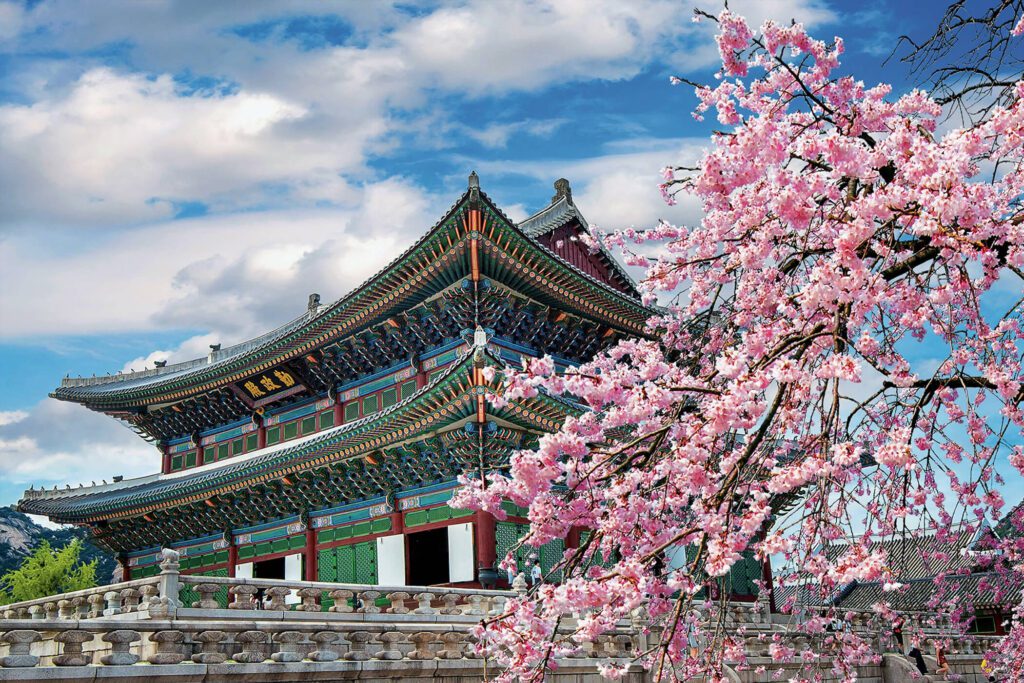
Spring reveals Seoul at its most measured: blossom along palace walls, pale light on tiled rooftops, and the formal lines of courtyards softened by new growth.

At Gyeongbokgung Palace, you spend time among the architecture and gardens of the Joseon dynasty, which shaped Korea’s court culture, social order and aesthetic values for over 500 years. The scale of the palace communicates authority through space and symmetry.

At Jongmyo Shrine, the restraint is more pronounced still. Built to house the ancestral tablets of Joseon kings and queens, the shrine is stripped of decoration. The silences here are deliberate.

In Bukchon Hanok Village, you walk narrow lanes between preserved traditional houses. The neighbourhood sits between two palaces, and the architecture reflects the same principles of order and proportion that shaped the wider city.

Later in the day, you take part in a mother-of-pearl craft experience: a traditional Korean art form in which shell is cut, shaped and inlaid onto lacquered surfaces with patience and precision.

Day 4
Seoul: Cooking, Contemporary Life and Free Afternoon

The morning begins in the kitchen. A Korean cooking class introduces you to the logic of the cuisine: balance, fermentation, seasonality and the use of ingredients that have been central to Korean domestic life for centuries. You prepare and share a meal together.

The afternoon is yours. After a hands-on morning, the time is well suited to exploring Seoul’s contemporary daily life at your own pace. The neighbourhood around the hotel offers galleries, design shops, specialist bookstores, skincare boutiques and the kind of café culture that Seoul does particularly well. Your guide is available throughout if you would like suggestions.

Day 5
Seoul: Gardens, Water and the Shape of the City

Today the focus shifts to how nature is woven into urban life.

Seoul Botanic Park is a contemporary landscape garden that brings together plant collections from several climate zones. The glasshouses and seasonal plantings reflect a considered approach to urban ecology that has become part of how Seoul presents itself.

From there, you continue to Seonyudo Park, a former water purification plant on a small island in the Han River, now transformed into a public garden. The industrial past is deliberately visible in the design: the old structures have been kept and rewoven into the landscape.

In the late afternoon, you board a river cruise on the Han. The city opens from the water: bridges, wooded banks and, in spring, cherry trees along the shoreline.

Day 6
Seoul to Jeju: Arrival on the Island

This morning you transfer to Gimpo Airport for a short domestic flight to Jeju Island, approximately one hour south of Seoul.

Jeju is a different register entirely. The island sits on a volcanic base, and its landscape, culture and social history are distinct from the mainland. The pace is slower, the coastline feels elemental, and the air carries salt and wind off the sea.

On arrival, you transfer to your hotel near Hamdeok on the north coast. The afternoon is left open: a moment to step into island time after four days in the city. A walk along the coast, time by the water, or simply rest are all sensible uses of it.

Day 7
Jeju: Women, Sea and a Different History

Jeju’s most singular cultural tradition is the haenyeo: women divers who have harvested the sea without breathing apparatus for generations, building an independent economy and a social structure that, in significant ways, ran counter to the Confucian hierarchy of the mainland.

You begin at the Haenyeo Museum, which traces their history, practice and ecological knowledge. From there, you travel along the eastern coast to Seongsan Ilchulbong Tuff Cone, formed by an underwater volcanic eruption, rising from the sea in a precise volcanic form. The scale and geometry here are unlike anything on the mainland.

At Seopjikoji Cape, the coastline opens to a wide horizon. The wind and light here have a particular quality.

In the evening, you share a haenyeo-style dinner accompanied by a traditional performance: an occasion that gives the day’s cultural context a fitting close.

Day 8
Jeju: Tea, Land and the Volcanic Coast

The west of the island shows Jeju at a slower, more contemplative pace.

At Hallim Park, you walk through gardens that reflect the island’s volcanic geology: lava tubes, basalt formations and native planting that feel less composed than city parkland and more simply present.

Hyeopjae Beach offers a stretch of white sand alongside black volcanic rock. This is not a beach developed for tourism; it is part of the island’s coastline.

At O’Sulloc Tea Plantation, you walk among rows of green tea on slopes above the sea. The plantation is one of the few in Korea. The crop carries associations with ceremony, restraint and seasonal attentiveness that run through much of Korean culture, and the landscape here reflects them.

The day ends at Daepo Jusangjeolli Cliff, where long hexagonal basalt columns descend to the sea, formed by the slow cooling of ancient lava. The geometry is precise and almost architectural.

Day 9
Jeju to Andong: Into the Interior

This morning you transfer to Jeju Airport for a short flight to Daegu, approximately one hour. From Daegu, you travel by road to Andong, a journey of approximately 90 minutes through the inland landscape of North Gyeongsang Province.

Andong is where Confucian culture is most visibly intact in contemporary Korea. In Hahoe Village, a UNESCO World Heritage settlement, the architecture, spatial organisation and daily customs still reflect the clan values that governed Korean society for centuries. The village sits in a curve of the Nakdong River, and the landscape around it is quiet and unhurried.

In the afternoon, you take part in a traditional soju brewing experience. What is made here is not the commercial product; it is the original: a small-scale craft tied to local identity, seasonal rhythm and the hospitality traditions of this particular place.

In the evening, you gather for dinner and spend the night at Rakkojae Hahoe Hanok Hotel. The rooms are structured around courtyards. The wood, stone and hanji paper of a traditional hanok create a quiet that is different from any hotel.

Day 10
Andong to Gyeongju: The Silla Inheritance

From Andong, you travel approximately 90 minutes to Gyeongju, once the capital of the Silla Kingdom, which ruled much of the Korean peninsula for nearly a thousand years. The city carries an unusual concentration of archaeological and architectural heritage.

In spring, the Daereungwon Tomb Complex is edged with pale azalea and new grass. Large grass-covered burial mounds rise from the city centre with quiet authority. You spend time in and around the complex, considering what the scale of the tombs communicates about Silla ideas of power and continuity.

At Hwangnidan-gil, a street of low shopfronts, cafés and design studios that has grown up beside the ancient tombs, the contrast between old and contemporary Gyeongju is plain and interesting. It is worth time.

Cheomseongdae Observatory is one of the oldest surviving astronomical structures in East Asia, built in the 7th century. Its curved stone form and precise alignment reflect a culture in which scientific inquiry and ritual were not separate categories.

The afternoon is given to Bulguksa Temple and Seokguram Grotto. Bulguksa was built in the 8th century to represent the structure of a Buddhist paradise. Seokguram, a stone grotto on the hill above it, houses a granite Buddha facing the sea.

Day 11
Gyeongju to Busan: The Coastline and the Sea

From Gyeongju, you travel approximately 90 minutes to Busan, Korea’s second city and its largest port. After the interior of Andong and the ancient landscape of Gyeongju, Busan is an opening out: a city that faces the sea and has always been shaped by movement, trade and the arrival of the new.

The day is a coastal orientation. Blueline Park follows the route of a disused railway above the coast, offering long views over the sea and the shore below. From there, you move along the coastline through Haeundae, Busan’s most established beach neighbourhood, and on to Gwangalli Beach, where the bay and the lit bridge define the city’s contemporary image.

The contrast with inland Andong, where landscape and tradition turned inward, is deliberate and part of what the route offers. Busan works outward, and that change of register is a considered part of the sequence.

Day 12
Busan: Markets, Neighbourhoods and Farewell

A full day in Busan, moving through layers of the city’s character.

Gamcheon Culture Village is built into a steep hillside above the port, originally settled by refugees during the Korean War. Over decades, artists and residents have transformed it into a neighbourhood of painted walls, narrow paths and small installations. It is a place with a clear origin story, and the colour and energy here feel earned rather than invented.

From there, you move into the markets. Bupyeong Kkangtong Market is one of Busan’s oldest indoor markets, its name derived from the tin goods traded by American military base vendors in the 1950s. Today it is a working food and goods market with a particular atmosphere. Jagalchi Fish Market, on the waterfront, is one of the largest fish markets in Korea: loud, practical and entirely itself.

In the late afternoon, a walk along the Oryukdo Skywalk offers views back across the coast and the sea that Busan has always faced.

The evening closes with a farewell dinner.

Day 13
Busan to Seoul to Johannesburg

This morning you transfer to Busan Station and board the KTX high-speed train to Seoul, a journey of approximately two and a half hours back across the peninsula. On arrival at Seoul Station, you transfer to Incheon International Airport for your evening departure to South Africa.

Lunch is included at the airport before you board.

Day 14
Arrival in South Africa

You arrive back in South Africa with a country’s worth of impressions: palace courtyards and island coast, village ritual, ancient tombs, markets, tea fields and the sea.

Your journey to South Korea begins with an overnight flight from Johannesburg to Seoul. The flight crosses several time zones, and you arrive in Seoul the following morning.

If you are joining this journey as a continuation of our Japan in Bloom tour, you fly today from Tokyo to Seoul instead.

You arrive at Incheon International Airport and transfer to your hotel in central Seoul. The afternoon is yours to rest and settle in after the overnight flight.

In the evening, you join your fellow travellers for a welcome dinner: a first introduction to Korean flavours and a chance to meet the group before the journey begins in earnest.

Spring reveals Seoul at its most measured: blossom along palace walls, pale light on tiled rooftops, and the formal lines of courtyards softened by new growth.

At Gyeongbokgung Palace, you spend time among the architecture and gardens of the Joseon dynasty, which shaped Korea’s court culture, social order and aesthetic values for over 500 years. The scale of the palace communicates authority through space and symmetry.

At Jongmyo Shrine, the restraint is more pronounced still. Built to house the ancestral tablets of Joseon kings and queens, the shrine is stripped of decoration. The silences here are deliberate.

In Bukchon Hanok Village, you walk narrow lanes between preserved traditional houses. The neighbourhood sits between two palaces, and the architecture reflects the same principles of order and proportion that shaped the wider city.

Later in the day, you take part in a mother-of-pearl craft experience: a traditional Korean art form in which shell is cut, shaped and inlaid onto lacquered surfaces with patience and precision.

The morning begins in the kitchen. A Korean cooking class introduces you to the logic of the cuisine: balance, fermentation, seasonality and the use of ingredients that have been central to Korean domestic life for centuries. You prepare and share a meal together.

The afternoon is yours. After a hands-on morning, the time is well suited to exploring Seoul’s contemporary daily life at your own pace. The neighbourhood around the hotel offers galleries, design shops, specialist bookstores, skincare boutiques and the kind of café culture that Seoul does particularly well. Your guide is available throughout if you would like suggestions.

Today the focus shifts to how nature is woven into urban life.

Seoul Botanic Park is a contemporary landscape garden that brings together plant collections from several climate zones. The glasshouses and seasonal plantings reflect a considered approach to urban ecology that has become part of how Seoul presents itself.

From there, you continue to Seonyudo Park, a former water purification plant on a small island in the Han River, now transformed into a public garden. The industrial past is deliberately visible in the design: the old structures have been kept and rewoven into the landscape.

In the late afternoon, you board a river cruise on the Han. The city opens from the water: bridges, wooded banks and, in spring, cherry trees along the shoreline.

This morning you transfer to Gimpo Airport for a short domestic flight to Jeju Island, approximately one hour south of Seoul.

Jeju is a different register entirely. The island sits on a volcanic base, and its landscape, culture and social history are distinct from the mainland. The pace is slower, the coastline feels elemental, and the air carries salt and wind off the sea.

On arrival, you transfer to your hotel near Hamdeok on the north coast. The afternoon is left open: a moment to step into island time after four days in the city. A walk along the coast, time by the water, or simply rest are all sensible uses of it.

Jeju’s most singular cultural tradition is the haenyeo: women divers who have harvested the sea without breathing apparatus for generations, building an independent economy and a social structure that, in significant ways, ran counter to the Confucian hierarchy of the mainland.

You begin at the Haenyeo Museum, which traces their history, practice and ecological knowledge. From there, you travel along the eastern coast to Seongsan Ilchulbong Tuff Cone, formed by an underwater volcanic eruption, rising from the sea in a precise volcanic form. The scale and geometry here are unlike anything on the mainland.

At Seopjikoji Cape, the coastline opens to a wide horizon. The wind and light here have a particular quality.

In the evening, you share a haenyeo-style dinner accompanied by a traditional performance: an occasion that gives the day’s cultural context a fitting close.

The west of the island shows Jeju at a slower, more contemplative pace.

At Hallim Park, you walk through gardens that reflect the island’s volcanic geology: lava tubes, basalt formations and native planting that feel less composed than city parkland and more simply present.

Hyeopjae Beach offers a stretch of white sand alongside black volcanic rock. This is not a beach developed for tourism; it is part of the island’s coastline.

At O’Sulloc Tea Plantation, you walk among rows of green tea on slopes above the sea. The plantation is one of the few in Korea. The crop carries associations with ceremony, restraint and seasonal attentiveness that run through much of Korean culture, and the landscape here reflects them.

The day ends at Daepo Jusangjeolli Cliff, where long hexagonal basalt columns descend to the sea, formed by the slow cooling of ancient lava. The geometry is precise and almost architectural.

This morning you transfer to Jeju Airport for a short flight to Daegu, approximately one hour. From Daegu, you travel by road to Andong, a journey of approximately 90 minutes through the inland landscape of North Gyeongsang Province.

Andong is where Confucian culture is most visibly intact in contemporary Korea. In Hahoe Village, a UNESCO World Heritage settlement, the architecture, spatial organisation and daily customs still reflect the clan values that governed Korean society for centuries. The village sits in a curve of the Nakdong River, and the landscape around it is quiet and unhurried.

In the afternoon, you take part in a traditional soju brewing experience. What is made here is not the commercial product; it is the original: a small-scale craft tied to local identity, seasonal rhythm and the hospitality traditions of this particular place.

In the evening, you gather for dinner and spend the night at Rakkojae Hahoe Hanok Hotel. The rooms are structured around courtyards. The wood, stone and hanji paper of a traditional hanok create a quiet that is different from any hotel.

From Andong, you travel approximately 90 minutes to Gyeongju, once the capital of the Silla Kingdom, which ruled much of the Korean peninsula for nearly a thousand years. The city carries an unusual concentration of archaeological and architectural heritage.

In spring, the Daereungwon Tomb Complex is edged with pale azalea and new grass. Large grass-covered burial mounds rise from the city centre with quiet authority. You spend time in and around the complex, considering what the scale of the tombs communicates about Silla ideas of power and continuity.

At Hwangnidan-gil, a street of low shopfronts, cafés and design studios that has grown up beside the ancient tombs, the contrast between old and contemporary Gyeongju is plain and interesting. It is worth time.

Cheomseongdae Observatory is one of the oldest surviving astronomical structures in East Asia, built in the 7th century. Its curved stone form and precise alignment reflect a culture in which scientific inquiry and ritual were not separate categories.

The afternoon is given to Bulguksa Temple and Seokguram Grotto. Bulguksa was built in the 8th century to represent the structure of a Buddhist paradise. Seokguram, a stone grotto on the hill above it, houses a granite Buddha facing the sea.

From Gyeongju, you travel approximately 90 minutes to Busan, Korea’s second city and its largest port. After the interior of Andong and the ancient landscape of Gyeongju, Busan is an opening out: a city that faces the sea and has always been shaped by movement, trade and the arrival of the new.

The day is a coastal orientation. Blueline Park follows the route of a disused railway above the coast, offering long views over the sea and the shore below. From there, you move along the coastline through Haeundae, Busan’s most established beach neighbourhood, and on to Gwangalli Beach, where the bay and the lit bridge define the city’s contemporary image.

The contrast with inland Andong, where landscape and tradition turned inward, is deliberate and part of what the route offers. Busan works outward, and that change of register is a considered part of the sequence.

A full day in Busan, moving through layers of the city’s character.

Gamcheon Culture Village is built into a steep hillside above the port, originally settled by refugees during the Korean War. Over decades, artists and residents have transformed it into a neighbourhood of painted walls, narrow paths and small installations. It is a place with a clear origin story, and the colour and energy here feel earned rather than invented.

From there, you move into the markets. Bupyeong Kkangtong Market is one of Busan’s oldest indoor markets, its name derived from the tin goods traded by American military base vendors in the 1950s. Today it is a working food and goods market with a particular atmosphere. Jagalchi Fish Market, on the waterfront, is one of the largest fish markets in Korea: loud, practical and entirely itself.

In the late afternoon, a walk along the Oryukdo Skywalk offers views back across the coast and the sea that Busan has always faced.

The evening closes with a farewell dinner.

This morning you transfer to Busan Station and board the KTX high-speed train to Seoul, a journey of approximately two and a half hours back across the peninsula. On arrival at Seoul Station, you transfer to Incheon International Airport for your evening departure to South Africa.

Lunch is included at the airport before you board.

You arrive back in South Africa with a country’s worth of impressions: palace courtyards and island coast, village ritual, ancient tombs, markets, tea fields and the sea.

Experience the vibrance of A Korean Spring

14-Day Small Group Tour of South Korea

Curated by a South African boutique travel operator | International join option

Maximum 16 travellers

This 14-day small group journey moves through Seoul, Jeju Island, Andong, Gyeongju and Busan in spring. The route has been shaped as a cultural progression: court ritual and craft in Seoul, volcanic island life and women’s history on Jeju, living Confucian tradition in Andong, the Silla inheritance in Gyeongju, and coastal energy in Busan. Each stop earns its place.

Our approach

We care about our guests

Seagull Travel & Tours crafts small group tours that offer luxury, convenience, and spontaneous moments of joy.

Explore

Seagull travels around the world

Seagull curates and facilitates exceptional travel experiences to premium destinations worldwide.

FAQs

We are here to help

The tour leader collects a set amount from each member of a tour. This kitty is then used to tip the local tour guide and city guides, bus drivers, any other assistants, and restaurant staff. We believe in tipping for good service as a token of appreciation, especially as many workers in tourism rely on tips to supplement their income.

Although we cannot apply on your behalf, we are more than willing to give guidance and assistance with completing forms. We do this for many clients on a near-daily basis. It does, however, remain the responsibility of the client to ensure that they get the correct visa on time.

Remember that we limit the number of guests on our tours. This means more time at stops and sites. We definitely do not do groups of 30 pax, where guests are rushed from one site to the other. There is enough time to explore on your own.

We always suggest USD/Euro 50 to USD/Euro 100 per person per day. As we mostly include two meals per day on our tours, this will be enough for lunch/dinner, some snacks, and memento shopping. Should you want to buy larger items, we suggest taking along your credit card. Remember to advise the bank that you will be travelling.

Once you have completed the form, you will receive an email with the itinerary which includes pricing, inclusions and flight options.

You can contact us at info@seagulltours.co.za or +27 42 296 0475